
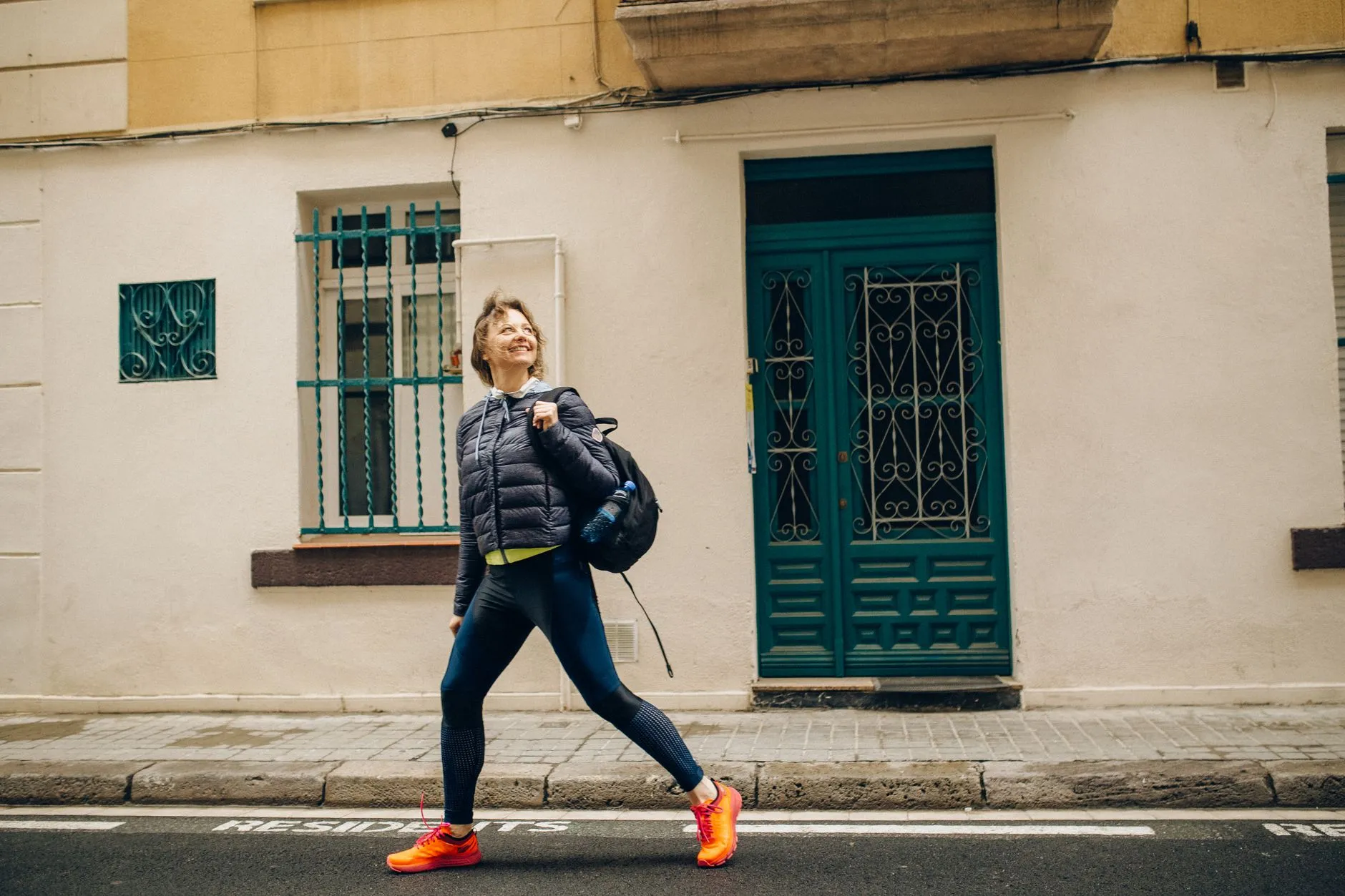
The Interval Trick That Makes a Regular Walk Count as a Workout
Tuesday evening, dog leash in one hand, phone timer in the other, I sped up until I passed four houses, then slowed back down for four more. My neighbor was watering her lawn and gave me the look you give someone talking to themselves on a street corner.
That look was worth it. What I was doing has a name: interval walking training, sometimes called Japanese walking because the method comes out of research done in Japan. The idea is almost insultingly simple. Walk fast for three minutes, walk slow for three minutes, repeat five times, and you’ve turned a half hour walk into something that works harder than a regular stroll.
Researchers Hiroshi Nose and Shizue Masuki at Shinshu University put about 250 middle-aged and older adults through the protocol for five months, four sessions a week, and compared them to a group doing continuous walking for the same amount of time. The interval group came out ahead on the things that matter for daily life: leg strength rose 13 to 17 percent, aerobic capacity climbed too, and blood pressure fell by roughly 9 points systolic and 5 diastolic, the kind of change usually associated with medication, not a walk around the block. The steady walkers, doing the same total time at one pace, barely moved on any of those numbers. The study, published in Mayo Clinic Proceedings, came out in 2007. It just took the rest of us almost twenty years to notice.
What sold me was more practical than the numbers: I already had a walk to hijack. I take the dog out most evenings anyway, so there was no new block of time to carve out, just a different way to spend the one I already had. First attempt, I lost count around interval three because the dog found something disgusting to investigate, and stopping to check my phone felt rude to whoever might be watching from a window. I gave up and just walked normally for the rest of the loop. Second attempt, I set a timer to buzz every three minutes instead of counting in my head, and that got me through the full thirty minutes.
The pace is easier to feel than to measure. Fast means you could get out four or five words before needing a breath. Slow means you’re actually recovering, not just coasting at your usual speed, since the whole benefit comes from the contrast between the two. I don’t check my heart rate for this. I go until talking gets hard, then ease off until it doesn’t.
You don’t need a track or a treadmill. Any walk you’re already doing works: the route to the bus stop, laps around the office parking lot on a break, the stretch between where you parked and the school pickup line. Pick a landmark, a certain number of houses, a length of sidewalk, and use that instead of watching a clock. I still count lamp posts more often than I check the timer, mostly because doing math while out of breath is annoying.
I tried the same trick in a grocery store parking lot once, parked at the far end on purpose, and walked fast to the cart corral, slow back to a landmark cart, fast to the doors. A guy loading groceries two spots down definitely noticed the pace changes. I did it anyway, because nobody in that parking lot was going to remember me in an hour, and I was done in less time than it would have taken to find a closer spot on a Saturday.
I don’t own a blood pressure cuff, so I can’t tell you if my own numbers moved the way the study’s did. What keeps me doing it is that thirty minutes of alternating pace goes by faster than thirty minutes at one speed. The fast bursts chop the walk into pieces, and pieces are easier to get through than one long stretch, the same way four short errands feel more doable than one long one.
If you’ve already got a walk on your calendar this week, try converting it instead of adding a new one. Set a repeating timer for three minutes, walk hard until it buzzes, ease off for three more, and do that five times before you head back inside.