
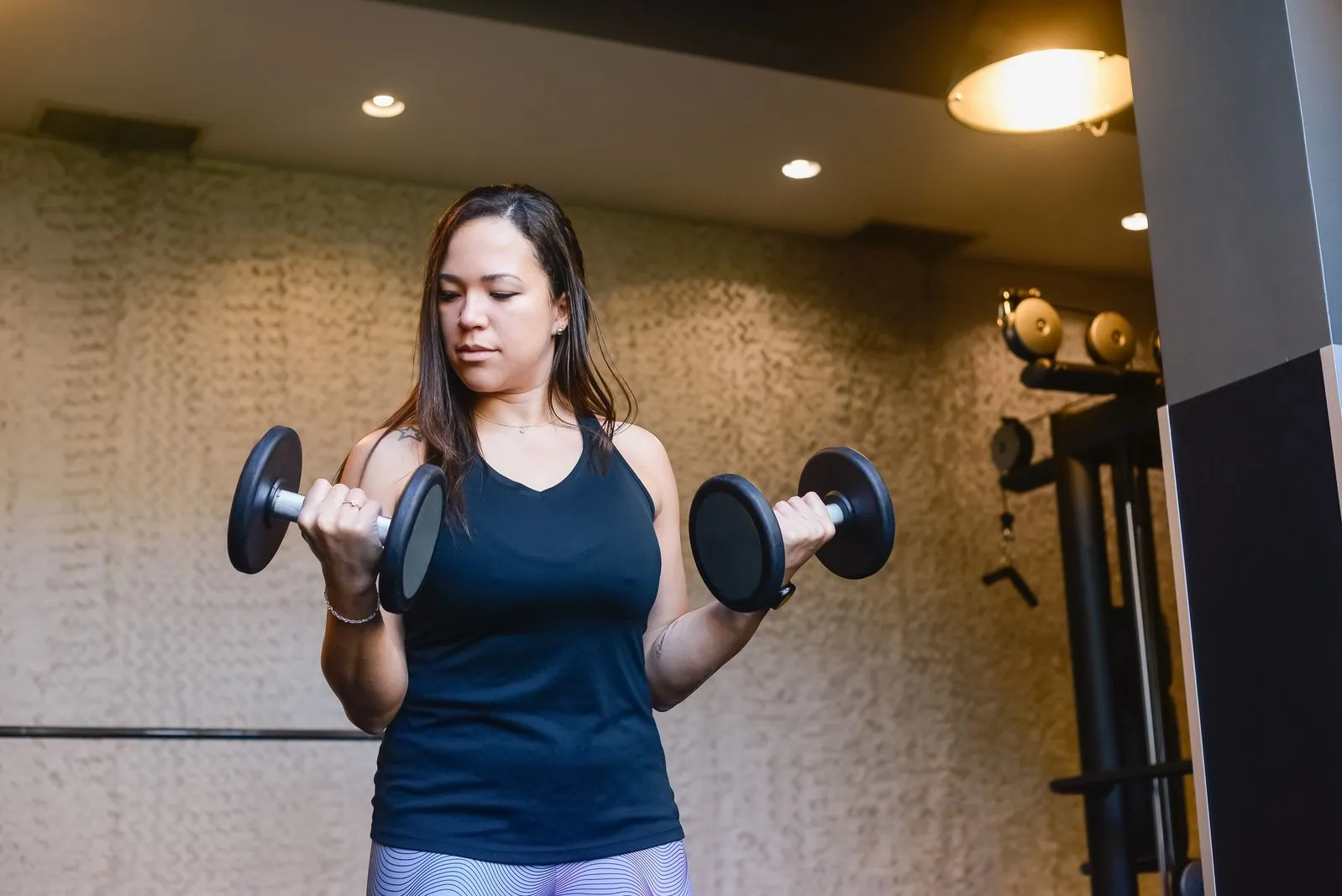
Arm Workouts With Dumbbells: Start With the Triceps
Walk past a dumbbell rack on a Tuesday evening and you’ll mostly see curls. Very little is happening for the back of the arm, which is the part that fills out a sleeve. It’s the most common way an arm workout goes sideways, and it costs nothing to fix.
Here’s the routine I’d hand someone with one pair of dumbbells, a floor, and twenty minutes twice a week. Triceps first, arm positions that change the result, short enough that you might still be doing it in October.
Which part of your arm should you train first?
The triceps, while you’re fresh. It has three heads to the biceps’ two, it runs down the back and side of your upper arm, and in most people’s training it gets whatever attention is left over after the curls.
One detail should shape how you train it. According to StatPearls, the long head of the triceps attaches to the shoulder blade rather than the arm bone, so it crosses the shoulder joint as well as the elbow. Lift your arm overhead and that head is already pulled long before you’ve moved a single rep.
The biceps does the same thing at the other end: it also crosses the shoulder, so letting your arms hang behind your torso puts it on stretch. Most arm routines ignore both facts.
Why holding the dumbbell overhead changes the result
The same exercise in a different arm position builds a measurably different amount of muscle. Sumiaki Maeo and colleagues had 21 people train one arm overhead and the other down at their side for 12 weeks, five sets of ten, twice a week. The overhead arms gained 19.9 percent in triceps size. The arms at their sides gained 13.9 percent.
Muscle volume gained over 12 weeks, same exercise, two arm positions
| Muscle measured | Arm trained overhead | Arm trained at the side |
|---|---|---|
| Whole triceps | 19.9% | 13.9% |
| Long head only | 28.5% | 19.6% |
That’s one study on 21 people, so treat the exact numbers loosely. The design is what makes it worth reading: each person was their own control, same load, same reps, one variable. Applying it costs nothing. Do your triceps work in the overhead position instead of pinned to your ribs, and your curls with your elbows drifting slightly behind you.
What’s the best arm workout with dumbbells?
Five exercises, twice a week, roughly twenty minutes. Three sets of each, in this order, resting about a minute between sets. If you’re short on time, the first three carry most of the work.
- One-arm overhead triceps extension: point your elbow at the ceiling and let the dumbbell sink low behind your head before you press back up.
- Dumbbell skullcrusher: lying down, lower both dumbbells past your ears rather than to your forehead, keeping your upper arms still.
- Incline dumbbell curl: lean back against a couch or a bench and let your arms hang straight down behind your torso, then curl from there.
- Hammer curl: palms facing each other the whole way, which brings in the muscle underneath the biceps and the top of your forearm.
- Dumbbell floor press: elbows tucked close to your ribs, press until your arms straighten and let your triceps finish the rep.
Two of those are pure triceps, one is a press that leans on the triceps, two are curls. That ratio is the argument.
Can you do arm workouts at home without a bench?
You can, and you don’t need to buy anything. Every exercise on the list has a floor or furniture version, and one is genuinely better at home: the floor stops your elbows at a sane depth on presses, which a bench doesn’t.
- No bench for skullcrushers: do them lying on the floor. Slightly shorter range at the bottom, and your shoulders stay supported.
- No incline for curls: stand up and let your elbows drift a few inches behind your ribs at the bottom of each rep. An incline gives you more stretch, but standing gets you most of the way there.
- No bench for the press: the floor press is the substitute. That’s why it’s on the list.
- No dumbbells at all: a backpack loaded with books, held by the top handle, works for overhead extensions and curls until you outgrow it.
The one thing worth buying eventually is a second, heavier pair. Arms adapt fast, and a single light pair turns every session into an endurance test.
Do women need a different arm workout?
No. Same five exercises, same order, same rep ranges, same progression. Nothing above changes.
What usually sits behind the question is a different goal: the back of the arm looking firmer. That gets treated as a targeting problem, so people do endless kickbacks aimed at one spot. Fat doesn’t leave the body that way. Rodrigo Ramírez-Campillo and colleagues pooled 13 studies covering 1,158 people aged 14 to 71 and found that training one limb produced no more fat loss in that limb than leaving it alone (pooled effect size of -0.03, p = 0.508).
So there are two separate jobs. Building the triceps and biceps is the routine above. Losing fat is what you eat and how much you move overall. Two hundred kickbacks does the first job badly and the second one not at all.
How many sets, how heavy, how often?
Twice a week, three sets per exercise, 8 to 15 reps, stopping each set when you’ve got about two good reps left in the tank. That comes to roughly six to nine hard sets per muscle per week, plenty unless you’re training for a stage.
Picking the weight is simpler than it looks. Choose a dumbbell you could manage 15 reps with if someone made you, then stop at 10 or 12. If a set ends and you could clearly have done five more, go heavier next session. Arms recover quickly, so two or three days between sessions is comfortable. If they’re still sore on day three, cut a set.
Progression is the boring part that matters. Add a rep, then another, and when you hit 15 on all three sets, move up in weight and drop back to 8. That loop is the whole plan.
Questions that come up
Do men need a different arm workout?
No. The routine above is the one I’d give anyone with a pair of dumbbells. What differs between two people is starting strength and how much weight they load, not which exercises belong in the session.
How long before I see a change?
Give it eight to twelve weeks of consistent training before judging anything by sight, and expect strength to move first. You’ll be adding weight to the overhead extension weeks before you notice anything in a mirror. That gap is normal, and it’s the reason most people quit at week four.
Should arms get their own training day?
They don’t need one. Five exercises fit at the end of an upper body session, or on their own if that’s what actually gets done. A dedicated arm day is fine if you enjoy it, though it’s a lot of gym trips for two small muscles.
Are curls alone enough?
They’ll build your biceps and leave the larger muscle on the other side of your arm untouched. If you only ever do one arm exercise, make it the overhead triceps extension. If you’ll do two, add the incline curl and you’ve covered both ends of the arm with the stretch working for you.