
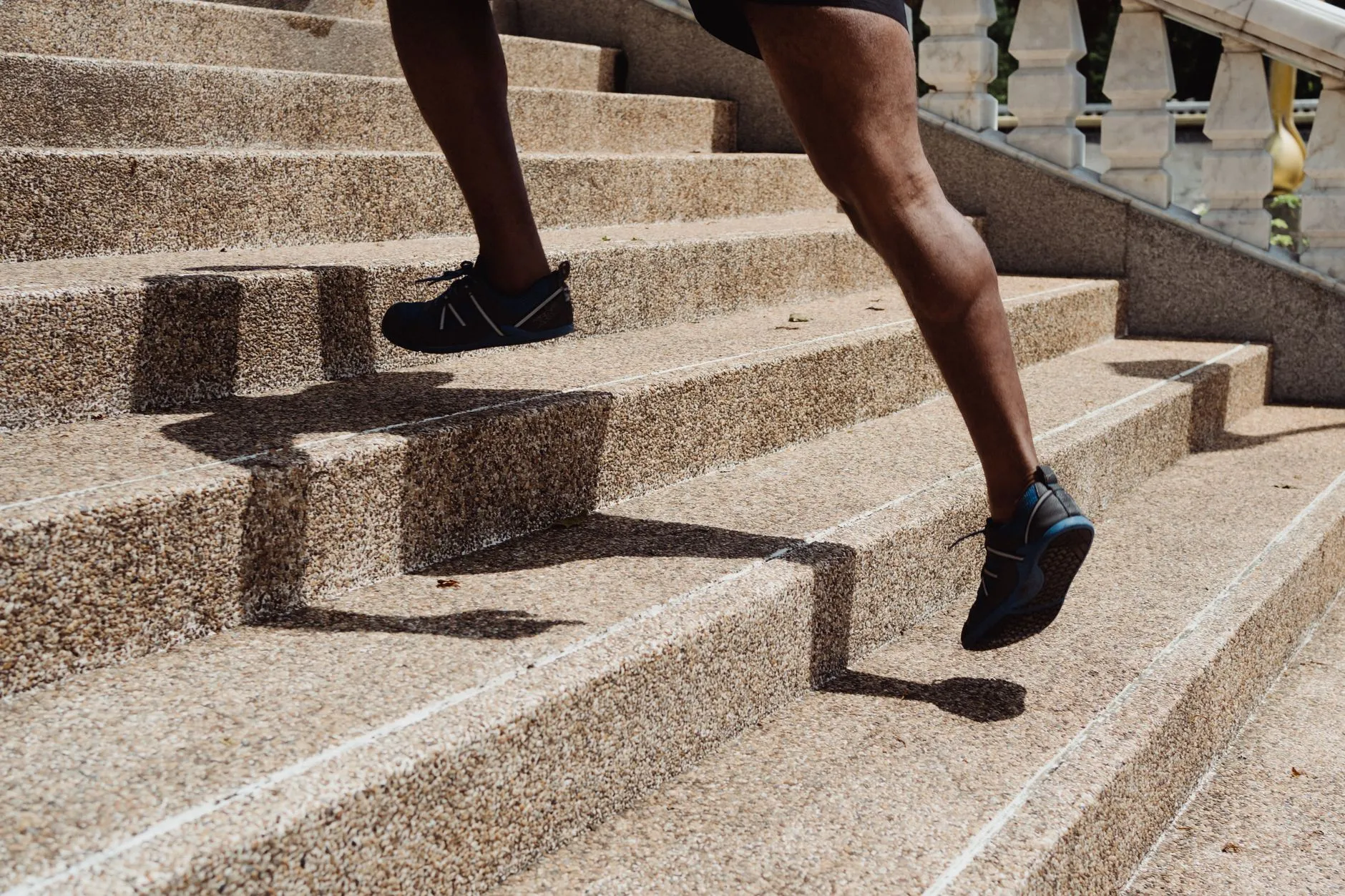
The Workout Hiding in Your Stairwell
I was on a work call last winter, pacing my kitchen because sitting still on calls makes me twitchy, when I noticed the stairwell door down the hall. Twelve steps up, twelve back down. I muted myself, went up once fast enough to breathe hard, came back down, and was back at my counter before anyone noticed I’d left. It felt like cheating. It also felt like the only exercise I’d gotten that whole gray week.
That habit has a name now: exercise snacks, short bouts of vigorous effort done a few times across the day instead of in one dedicated session. It sounded like a rationalization for people who don’t want to go to the gym, which is exactly why I was skeptical. Then I looked at what the research actually measured.
Six weeks of stairs did what a treadmill habit usually gets credit for
Researchers at McMaster University and the University of British Columbia Okanagan, led by Madison Jenkins and Martin Gibala, had sedentary young adults do three fast climbs a day, three days a week, for six weeks: up a three-story stairwell as quickly as they could, rest an hour or so, repeat twice more. No warmup, no gear, just stairs and then back to whatever they were doing.
By the end, their peak oxygen uptake, the standard measure of cardiorespiratory fitness, had risen about 12 percent, while a control group doing no structured activity showed no change. The study, published in Applied Physiology, Nutrition, and Metabolism, put the climbers’ fitness at 8.27 to 9.25 METs on average, a real gain from a total of nine minutes of actual climbing a week, not the nine hours a gym habit usually asks for.
A larger 2025 review says the effect isn’t a fluke of one small study. A systematic review and meta-analysis in the Scandinavian Journal of Medicine & Science in Sports pooled 13 trials and 483 adults and found consistent gains in maximal oxygen uptake and peak power, plus drops in total and LDL cholesterol. It found no change in body weight or body fat, which is worth saying plainly. What actually improves here is cardiorespiratory fitness, your heart and lungs working better on the same schedule you already keep.
It doesn’t have to be a stairwell
The broader case comes from wearable data, not a lab. Emmanouil Stamatakis and colleagues tracked activity in adults who said they don’t exercise, using UK Biobank wearable data, and found that the ones who got just a few minutes of vigorous, incidental movement a day, the kind that happens rushing for a bus or hauling bags up a curb, had close to 50 percent lower rates of cardiovascular death than the ones who got none. The study, published in Nature Medicine, never asked anyone to exercise. It measured what already happens to people who move hard for a minute here and there.
I tried folding that into a trip a few months back, an airport with a broken escalator and four floors between me and my gate. First time, bag on my shoulder, I walked it at my normal pace, not wanting to look like I was racing someone. On the way back a few days later, empty-handed, I took it fast enough to be breathing hard by the top, and had to stand at the gate desk a second before I could talk normally. Only one of those two climbs was hard enough to count as the kind of burst this research is about, and it happened while I wasn’t thinking about exercise at all.
The habit stuck at home for a boring reason: my stairwell is twenty feet from where I work. I don’t so much decide to use it as notice it’s there between meetings.
If you want to try the actual protocol from the research instead of a looser version:
- Find a stairwell or a flight of stairs you pass regularly.
- Climb it as fast as you comfortably can, no jogging, just quick steps.
- Rest until your breathing settles, a minute or two is enough.
- Do that two more times, spaced out through the day if you can.
- Repeat on most days, not every day.
You don’t need a gym bag for this one. The next time you’re near a staircase you’d normally take slowly, take it like you’re late for something, and see how your breathing feels at the top.