
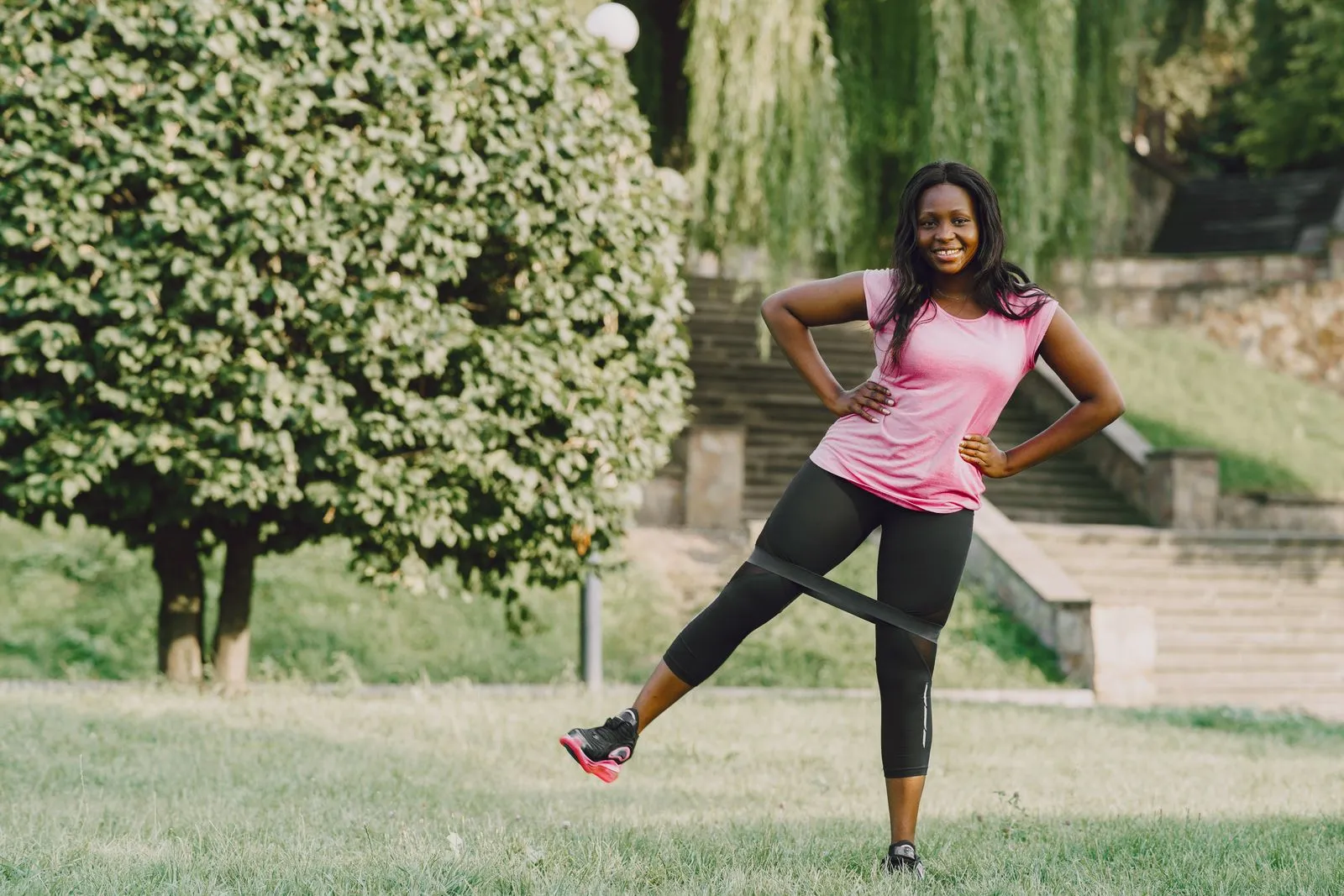
Leg Training With Bands: How to Make a Rubber Loop Actually Hard
A resistance band costs about as much as a sandwich and fits in a coat pocket, which is why so many people own one and so few train their legs with it. The band comes out, you do twenty side steps, your hips burn, and you file it away as a warm-up toy.
That’s a waste of a good piece of equipment. Bands build real leg strength, but only if you use them at the stretch where they actually produce force, and that part rarely makes it onto the packaging. This covers which leg exercises are worth doing with a band, where the band should sit, how much load you’re really getting, and how to make it harder over time.
Can you actually build leg strength with bands?
Yes, and the research is more settled than the gym-floor arguments suggest. A 2019 systematic review and meta-analysis in SAGE Open Medicine by Jaqueline Lopes and colleagues pooled eight randomized trials covering 224 people aged 15 to 88 and found no significant difference in strength gains between elastic devices and conventional ones like machines and dumbbells, for either the upper or lower body.
The catch is matching the effort. A 20 kilo dumbbell weighs 20 kilos at the top of the rep and at the bottom. A band weighs whatever you’ve stretched it to, so the difficulty of a band set is a decision you make when you set up, not a number stamped on the equipment. Most people make that decision far too gently and then conclude bands don’t work.
How much resistance does a band really give?
Less than the label claims, and less than it feels. Kazuhiro Uchida and colleagues measured Thera-Band tension at different stretch lengths for a 2016 paper in the Journal of Physical Therapy Science. Stretched to double its resting length, a red band produced 1.60 kilogram-force, green 1.82, blue 2.51, and black 3.28. They also found the manufacturer’s own tension numbers ran high, by 13 percent for red and by 44 percent for gold.
So a band at a polite stretch is giving your legs two or three kilos. That explains the squat that feels like nothing on the way down and like something on the way up: band tension climbs with percent elongation, so the load only shows up near the top of the movement. The same red band pulled to triple its resting length gives 2.26 kgf instead of 1.60, and stiffer colors climb faster still.
Three fixes for a band that feels easy, none of which cost anything:
- Use less band. Stand on more of it, wrap it once around your hand, or shorten the loop so the same movement stretches it further.
- Move up a color. Red to green is a modest bump. Green to black is close to double.
- Start each rep from an already-stretched position rather than from slack, so the easy part of the range disappears.
Which leg exercises are worth doing with a band?
The same movement patterns as any leg day: a squat, a hip hinge, something that works one hip at a time, and a calf raise. Bands suit hinges and hip abduction especially well, because their resistance rises as the movement finishes, which is where your hips are strongest anyway.
- Squats with bands: stand on the middle of the band, loop the ends over your shoulders, sit down between your heels and push the floor apart with your feet.
- Band good morning: band under both feet and behind your neck, knees softly bent, push your hips straight back until your hamstrings tighten, then drive them forward.
- Monster walk: band above the knees, drop into a half squat, step forward and outward at an angle, and refuse to let your knees drift inward.
- Seated band hamstring curl: anchor the band in front of you at ankle height, hook your heels into it, drag them back under the chair, release over three seconds.
- Hip extension with bands: band around one ankle, anchored ahead of you, drive that heel back and slightly up, hold a beat at the top before it snaps you forward.
- Calf raises with bands: stand on the band holding both ends, rise all the way onto your toes, pause, lower slowly enough that you feel the stretch.
Four of those in a session is plenty. Six is a long evening for no extra benefit.
Where should the band sit, above the knees or around the ankles?
Start above the knees and move it down your legs as you get stronger. A 2025 review in the Journal of Functional Morphology and Kinesiology by Ángel González-de-la-Flor reports that shifting the band from the knees toward the ankles and feet lengthens the lever arm and increases resistance torque, which raises activation of both the gluteus medius and maximus. Forefoot placement produced the highest glute activation with comparatively less tensor fasciae latae involvement.
Same review, same exercise, useful numbers: lateral band walks put the stance-leg gluteus medius at roughly 30 to 50 percent of maximum voluntary contraction, and the moving leg at 20 to 30 percent. That’s respectable for something you can do next to your desk.
The posture matters as much as the placement. Standing tall and stepping sideways turns the exercise into a hip flexor drill. Sink into a half squat first, keep your chest up, and let the glutes do the work. If your hips are burning within eight steps, the band is where it should be. If you can do thirty steps and feel nothing, move it toward your ankles before you buy a stiffer one.
What does a band leg workout look like for a beginner?
Two sessions a week, four exercises, three sets each, 12 to 20 reps per set. The rep range runs higher than it would with dumbbells because a band spends part of every rep barely loaded, so you need more total repetitions to accumulate the same hard work.
- Squats with bands, 3 sets of 15
- Band good morning, 3 sets of 12
- Monster walk, 3 sets of 20 steps in each direction
- Calf raises with bands, 3 sets of 20
Rest a minute between sets, two if you need it. The whole thing runs about 20 minutes once you stop looking things up.
Progression is where most band programs stall, because adding reps forever turns strength work into endurance work. My rule: once you reach the top of the rep range without your last three reps slowing down, shorten the band or move up a color and drop back to the bottom of the range. Expect two to three weeks per step at first, longer after a few months. Write down the color and the setup you used, because a band gives you no other way to know whether last month was harder than this one.
Questions that come up
How often should you train legs with bands?
Twice a week, with at least one day between sessions, covers most people. A third day is fine if you feel good, but the second session is the one that does the work for strength.
Can bands build muscle, or only tone?
They build muscle. Muscle responds to mechanical tension and hard sets taken close to failure, and a band delivers both once you’ve stretched it enough. The Lopes meta-analysis found strength outcomes equal to machines and dumbbells, and in beginners strength and size move together.
Which band should you buy first?
A set of three or four loop bands rather than a single one, since progression depends on having a stiffer option waiting. If you can only get one, pick something in the green-to-black range for legs. The light colors are made for shoulders and rehab, and your legs will outgrow them in a fortnight.
Do bands snap?
Latex degrades with sunlight, heat, and small nicks, so keep them out of the car and check them for tears before you loop one behind your neck. Replace a band the moment the surface looks cracked. A band that fails under load moves fast, and your face is often in the way.
Pick one band exercise from the list, do three sets of it tonight while something’s cooking, and note the color you used.