
How to Build a Leg Day Workout You'll Actually Repeat
I did my first real leg day in the kitchen, squatting next to the stove while pasta water came to a boil. No gym, no barbell, just bodyweight squats between stirring, and my legs were sorer two days later than after any upper body session I’d done. Legs are the biggest muscles you have, and a leg day that trains all of them doesn’t need to be complicated.
This covers what belongs in a leg day workout, how to do it without a gym, how often to repeat it, and the knee, soreness, and single-leg questions that come next.
What exercises belong in a leg day workout?
A leg day needs three movement patterns: a squat, a hip hinge, and a lunge or step, plus a calf raise if you have time. Together they train your quads, hamstrings, glutes, and calves without needing a dozen separate exercises.
The squat pattern (knees and hips bending together) hits your quads hardest. The hip hinge (bending mainly at the hips, knees soft) shifts the work to your hamstrings and glutes. The lunge or step trains one leg at a time, which squats and hinges skip. Pick one of each:
- Goblet squat: hold a dumbbell at your chest, sit your hips back and down, keep your heels flat.
- Romanian deadlift: hinge at the hips with a slight knee bend, push your hips back until your hamstrings stretch, keep the weight close to your legs.
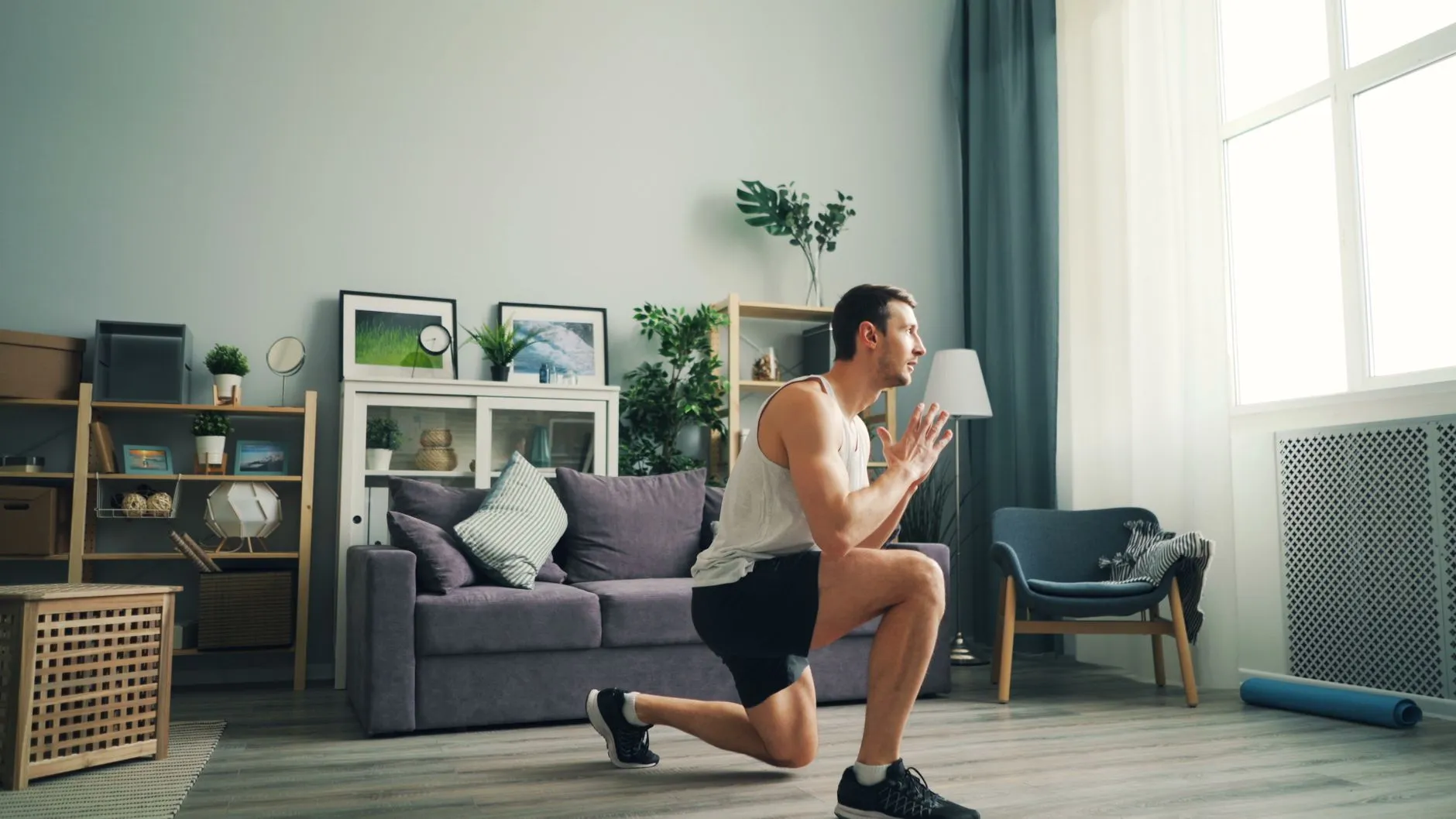
- Split squat: one foot forward, one back, drop your back knee straight down instead of letting it drift forward.
- Standing calf raise: rise onto your toes, pause a beat at the top, lower slow.
Three or four sets of each, eight to twelve reps, covers a full session. Start with a weight you could do fifteen reps of, and add more once twelve reps with good form feels easy two sessions in a row.
How do you do leg exercises at home with no equipment?
Bodyweight versions of the same three patterns train the same muscles. You add reps, a pause at the bottom, or a slower lowering phase to replace the load a dumbbell would give. A kitchen counter or a chair back is the only equipment most people need, for balance, not resistance.
That kitchen leg day became my template for a while:
- Bodyweight squat: feet shoulder-width, sit back like you’re reaching for a low chair, three-second lowering phase.
- Single-leg glute bridge: lie on your back, one foot planted, lift your hips, squeeze at the top.
- Step-up with knee raise: step onto a stair or a sturdy box, drive through your planted heel, bring your other knee up.
- Chair squat: lower until you tap the seat, don’t sit, stand back up. A good starting point if a full bodyweight squat feels like too much too soon.
Fifteen to twenty reps a set works better than eight to twelve here, since bodyweight alone is lighter than most people lift with a dumbbell.
How many leg workouts a week do you need?
Two sessions a week beats one, according to a 2019 meta-analysis by Brad Schoenfeld and colleagues in the Journal of Sports Sciences that pooled the training-frequency research. Once your total weekly work is similar, though, three sessions doesn’t reliably beat two. Frequency matters less than showing up.
For most people starting out, that means two sessions with a rest day between them, or spaced further apart around a busy week. If your legs are still sore from a Monday session, moving to Wednesday or Thursday is a reasonable swap, not a reason to skip the week.
What does a full leg day routine look like start to finish?
A leg day routine runs in three parts: warm up the hips and ankles, hit the main lifts while you’re freshest, then anything lighter at the end. The heaviest, most technical move, usually the squat, goes first, before fatigue reaches the exercise where form matters most.
A session built from the exercises above might run like this:
- Warm-up: bodyweight squats and walking lunges, to raise your heart rate and open your hips.
- Main lift: goblet squat or bodyweight squat, three to four sets.
- Second lift: Romanian deadlift or single-leg glute bridge, three sets.
- Finisher: split squats and calf raises, two to three sets each.
The whole thing takes 35 to 45 minutes without phone breaks between sets. If you’re short on time, keep the squat and the hinge and drop the finisher: two solid exercises beat five rushed ones.
Do you need single-leg exercises, or is squatting enough?
Add one single-leg move. It builds strength differences between your legs that squatting alone doesn’t reach. A study in the Journal of Strength and Conditioning Research had rugby players train rear-foot-elevated split squats or back squats twice a week for five weeks. Both gained similar overall strength, but the split squat group gained more per leg.
Practically, split squats and step-ups pull double duty: they build the same muscle as a squat, plus the balance and per-leg strength a two-legged squat can hide an imbalance behind.
Why are your legs so sore after leg day, and when should that worry you?
Muscle soreness one to three days after leg day is normal. It comes from the lowering phase of squats and lunges, where your muscle lengthens under load and gets microscopically strained. Sharp pain in a joint, during the set or right after, is different, and it means stop rather than push through.
Two days after that kitchen leg day, I took the stairs at work sideways because walking down normally made my quads scream. That’s ordinary soreness, not injury, and it fades faster than you’d think: my second kitchen leg day still hurt the next day, but by the fourth I took the stairs normally again. A joint hurting sharply during a squat or lunge, rather than the muscle aching afterward, means your form or your load, not soreness to wait out.
Questions that come up
Are squats bad for your knees?
No. A 2024 scoping review in Frontiers in Sports and Active Living looked at 15 studies on deep squats and knee health. Fourteen found no negative effect, and some linked deep squatting to thicker, more resilient cartilage. The old fear of squatting “past 90 degrees” traces to a heavily criticized, never-replicated 1961 study.
Do women need a different leg workout than men?
No. The muscles and movement patterns are the same for everyone. What changes is the goal: someone chasing strength lifts heavier for fewer reps, someone chasing endurance does more reps at a lighter load. Pick a rep range by your goal, not your gender.
Does walking or running count as leg day?
Not the same way. Walking and running are mostly endurance work; they don’t load your legs enough to build strength or size the way squats and lunges do. They’re a good complement to leg day, not a replacement for it.
What if your knees already hurt, should you skip leg day?
Not necessarily, but change the exercise before you cut it. Shallower squats, step-ups instead of lunges, or a leg press instead of a free-standing squat train the same muscles with less shear on the joint. If the pain is sharp, swollen, or doesn’t settle within a day, see a physical therapist instead of guessing at a fix.