
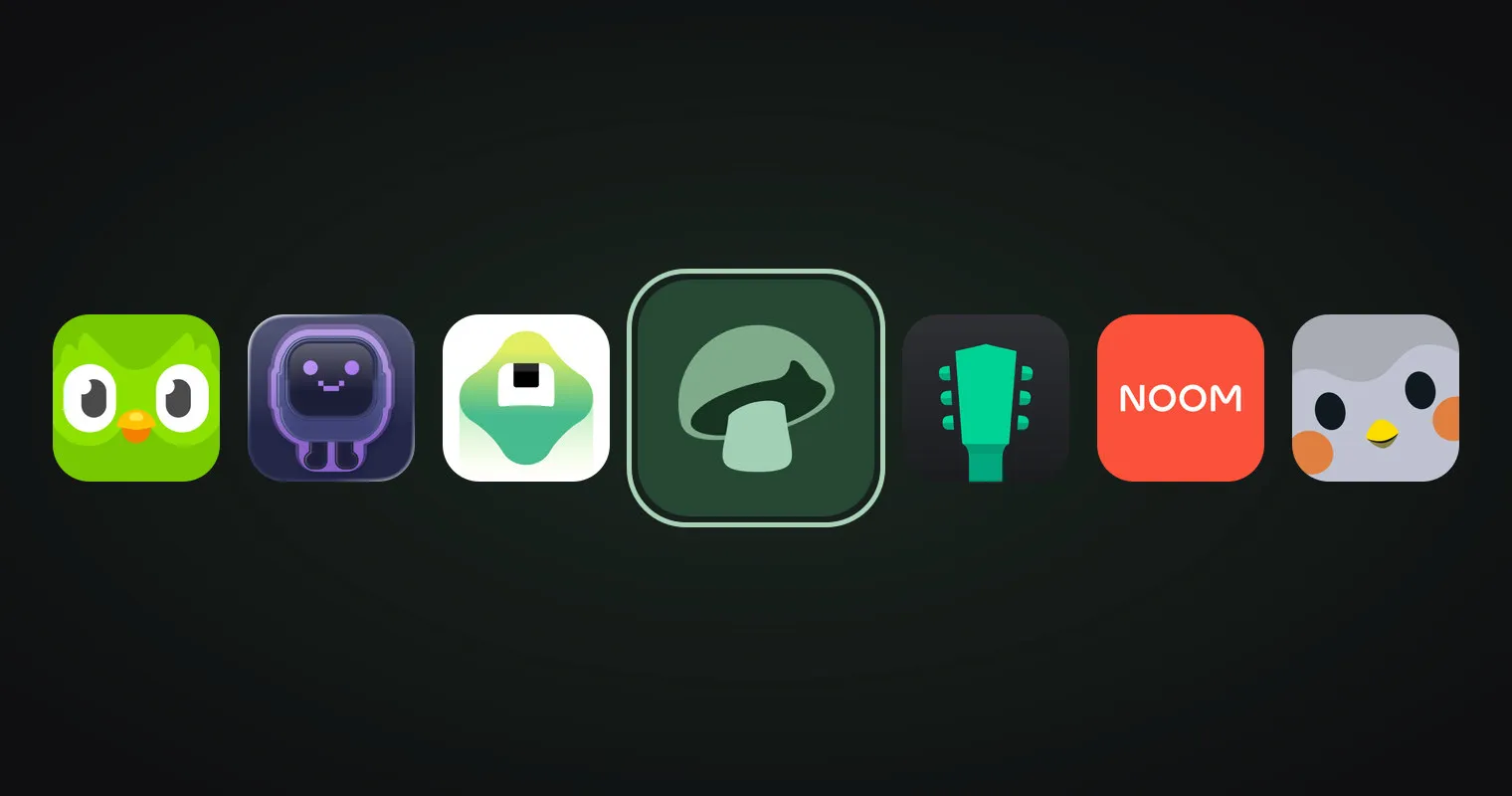
A Duolingo for everything: six streak apps and what each one really rewards
Duolingo worked out something the rest of the app store has been copying ever since: most people will do a lot to avoid breaking a number. Learn Spanish, maybe. Avoid breaking the number, definitely.
The mechanic is easy to steal. Make the daily unit short enough to finish standing on a bus, put a counter on it, and send the counter to zero when someone skips. That shape now exists for coding, piano, calorie tracking, flashcards and exercise. We build the exercise one, so read that section the way you’d read a chef reviewing his own restaurant.
The useful question across all of them is not which app is best. It’s what the streak is paying you to do, because that changes enormously from category to category while the interface stays nearly identical.
Mimo made coding a five minute lesson, with the tradeoff that implies
Mimo is the one people actually call the Duolingo for coding, and it earns the nickname: short lessons in Python, JavaScript, SQL and HTML, plus streaks and leaderboards. The streak here pays you to finish a lesson, and for the first months of syntax that’s an honest trade, because typing for loops on 40 separate days beats reading about them once.
The limit shows up later. Reviewers who like the app keep landing on the same sentence: great for momentum, capped on depth. A five minute lesson can teach you what a function is. It can’t sit with you through the afternoon where your code runs fine and returns the wrong number, which is most of programming.
Brilliant gives you one problem a day and rations the rest
Brilliant does math, science and computer science as a daily problem plus short interactive lessons, with XP and streaks layered on. The interesting design choice is that free accounts get a limited number of lessons per day. The app rations itself.
That inverts the usual incentive. Most streak apps want maximum time inside; this one caps your session and sends you away. If your goal is to think about probability more often than never, a capped daily problem is closer to the right shape than an unlimited course you’ll open twice.
Yousician is the one where you can’t fake the number
Yousician teaches guitar, piano, bass, ukulele and voice, and grades what you play in real time through your microphone. Stars, streaks, weekly leagues, the whole kit.
The microphone changes the economics. In most of these apps you can keep a streak alive with a minute of tapping the right answers. Here it only counts if you produce the sound, in time, on an instrument, so the number can’t drift far from the skill. That’s rarer than it should be.
Noom put the daily lesson on food, and that’s where this gets complicated
Noom is the daily lesson format applied to eating: short readings drawn from cognitive behavioral therapy about the habits behind your food choices, alongside logging what you eat. The lessons are the good part. The logging is where the mechanic can turn on you.
Albert Stumm reported for the Associated Press in June 2026 on the gaming features in nutrition apps, and the researchers he spoke to were direct about the risk. Isabella Anderberg, a psychologist at Flinders University who studies digital dieting, said calorie tracking can reinforce the behaviors of disordered eating for some people. Courtney Simpson, who directs eating disorder treatment at the Evidence-Based Treatment Centers of Seattle, said apps often set calorie goals far too low for any adult, and the streak then keeps people coming back to a target they were always going to miss. Simpson drew the line better than I could:
“It’s not that gamification itself is bad. It’s about what it is promoting.”
That sentence is the test for every app in this post.
Finch is the only one that refuses to punish you
Finch is self-care as a small bird you look after: breathing exercises, mood check-ins, journaling, tiny goals, and the bird grows as you do them. It tracks streaks. What it pointedly does not do is charge you for breaking one.
Miss a day and Finch nudges you back instead of showing you a zero. For a mental health app the reasoning is obvious once you say it out loud: guilt is the symptom, so a mechanic that manufactures guilt is working against the product. Every other app on this list could stand to ask whether its version of the streak does the same thing.
Exercise is where the streak breaks hardest, which is our problem
Cards on the table: we build Cooltivo, so weigh this accordingly.
A workout is not a lesson, and that breaks the format. You can do a Spanish lesson badly and still walk away with some Spanish. A token five minute session logged to protect a number teaches your body close to nothing, and it teaches you that the number was the goal. Apps that allow that get beautiful retention charts and mediocre results.
Cooltivo’s bet is to make the check-in the thing instead of the count. Skip a day and your habitant asks what happened, then reshapes the week around your answer, which is a conversation rather than a penalty. The habitant grows with the habit, closer to Finch’s bird than to a counter. Whether that beats a hard streak for getting people to actually show up is the bet we’re making, and we’re early enough that the honest answer is we don’t have years of data yet.
Three questions before you install any of them
- What does the streak count, a minute of tapping or the actual skill?
- Does missing a day cost you something, and do you want that pressure in this part of your life?
- If the counter vanished tomorrow, would you still open it?
Pick the one category you’ve been meaning to start, install a single app, and set the daily goal to the smallest option it offers. The temptation is to start three at once on a Monday, which is how people arrive at Thursday with three broken streaks.